Binance Dust Conversion (tax not correct)

Describe the problem:
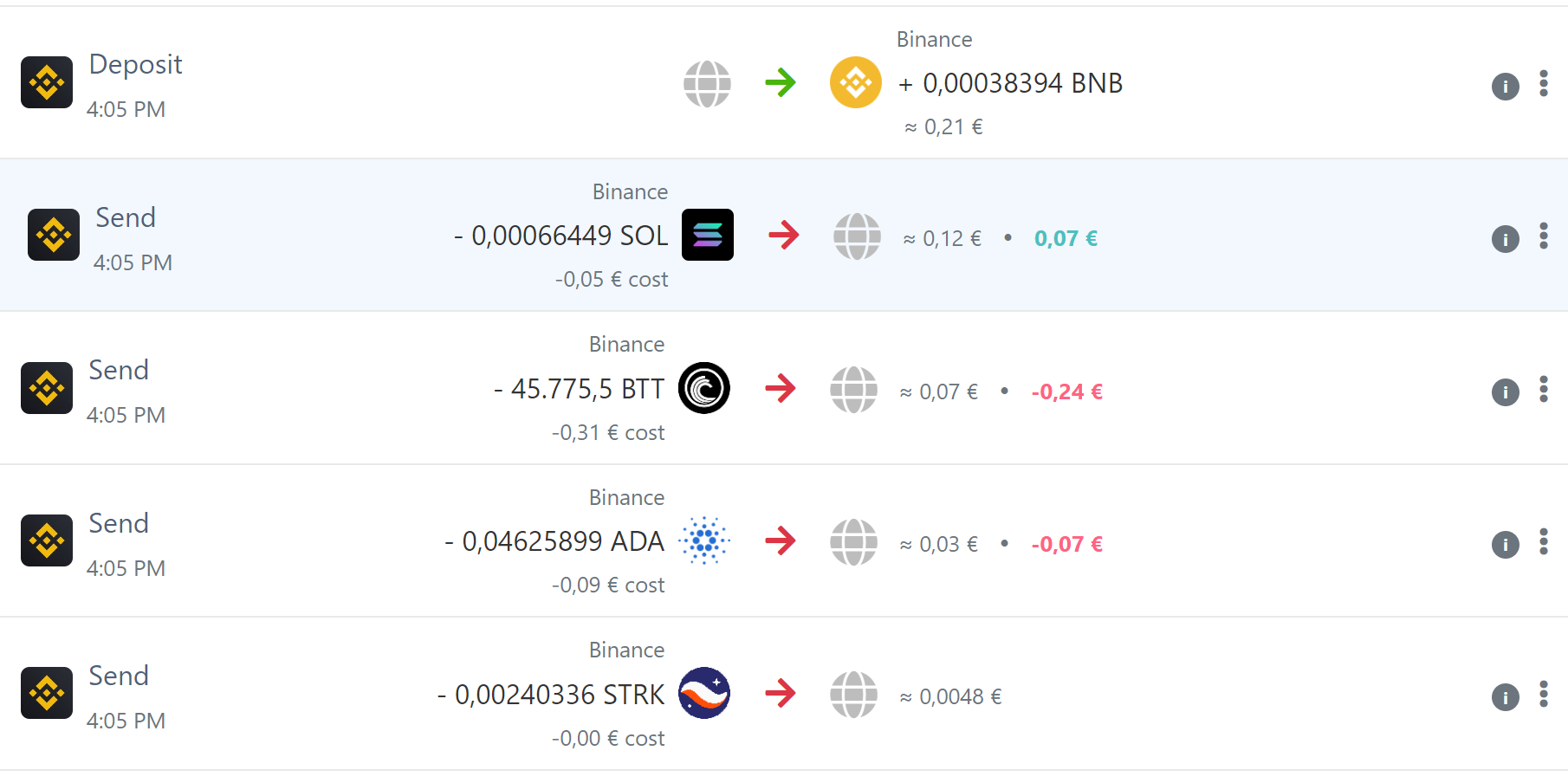
Problem with Binance Dust Conversions. I assume that if I leave this as “send” and “deposit” this is not correct, because I guess that “send” is like if I spend my criptos, and deposit is like an income, so my doubt is, if its not more correct to tag dust conversions sent as “Cost” and leave “Deposit” as it is, so Cost - Income(Deposit) = 0, is then the correct form for paying the correct Taxes?

Which exchange/wallet is this regarding?
Binance

How did you import data into this wallet?
CSV

What have you tried to fix this so far?
Merging is not possible. I

Hi @noliver

In this transaction, Koinly is currently showing that some tokens have been disposed of (sold) and BNB is purchased in return which is the way a trade is depicted (disposal of one token and purchase of another).

If you believe these should be tagged as “cost”, you can use the tag but make sure you consult with your tax advisor.

2 Likes

That is totally incorrect. A trade is not the same as some coins having been sent and some received. Having it classified as a send and a receive is wrong, it needs to be classifiable as an exchange, but you can’t because Koinly is missing a feature to let you exchange multiple types of coins for 1 type of coin.

Let me provide an example, not of multiple types, but to show that exchanging is not the same as sending and receiving. Let’s compare trading 1 BTC for 10 ETH to sending 1 BTC and receiving 10 ETH (or whatever amount of ETH makes sense for these scenarios) in order to prove they are very different.

Scenario A - Trading
1 BTC is exchanged for 10 ETH
In this scenario, you could owe taxes on the amount your BTC has gone up by, or to say it another way, you need to report your loss or gain. The fact that you end up with ETH is somewhat irrelevant, other than it is important to know you have some ETH now and the price you received it at. But you don’t owe taxes on having “received” the ETH as if that were income or anything like that.

Scenario B - Sending and Receiving
In this scenario, the sending and receiving are two separate events. Let’s say the BTC has not gone up or down in price from the point you originally purchased/received it. You would not owe any taxes for having sent it. But you would owe taxes for the amount of ETH you received, for the price 10 ETH are worth, as if it were income.

These two scenarios are extremely different in terms of how they affect taxes. In both scenarios you report your loss or gain on the coin sent or traded. But only in scenario B do you also end up owing taxes on the coins received as if they were pure profit/income. Koinly needs a way to trade multiple coins for one other coin, or possibly even multiple coins for multiple other coins, as a single trade/exchange transaction.

Hi @mindWanderer

Thanks for the explanation.

As you correctly mentioned, in a trade (e.g. BTC>>ETH), BTC is sold and gains are realized on it and ETH is purchased at the market price and no taxes here.

A “send” transaction in Koinly is considered a sale of the token at the market price. A “deposit” transaction is a purchase of tokens at the market price. Unlike what you mentioned, a deposit is not a taxable transaction. It is considered an investment and hence a tax-free transaction unless you apply a tag like “reward”, or “Income”,…

Check out What are transactions in Koinly for more information about the transactions in Koinly.

With that being said, this is how the data is imported into Koinly. If you believe that these transactions should be imported as trades, you can edit them, divide the BNB amount, and create trades manually.

1 Like

This was really helpful to know that deposits and treated this way. Apparently it was just an assumption on my part that if you can’t identify where a deposit came from or why it appeared there by labeling it in some other way, it would be considered income. That is basically how the IRS sees it in the US, if you have a mysterious deposit and you can’t say where it came form, it’s income. However if when Koinly says something is a deposit, it actually means a purchase at the current market price, this is quite a deceptive way to depict it as a deposit and a purchase are very different things. This essentially means Koinly is tricking its customers into reporting their taxes incorrectly.

There’s no trick or deception involved here. Thousands of CPAs use Koinly to help report their clients’ taxes, and we collaborate with top professionals to ensure tax compliance. That said, if you receive tokens into your wallet that are imported as deposits but have a special tax treatment and should be classified as income, it’s important that you manually tag those transactions as “income.”

You can read more here:

https://koinly.io/blog/security-and-compliance-update/

This topic was automatically closed 60 days after the last reply. New replies are no longer allowed.